


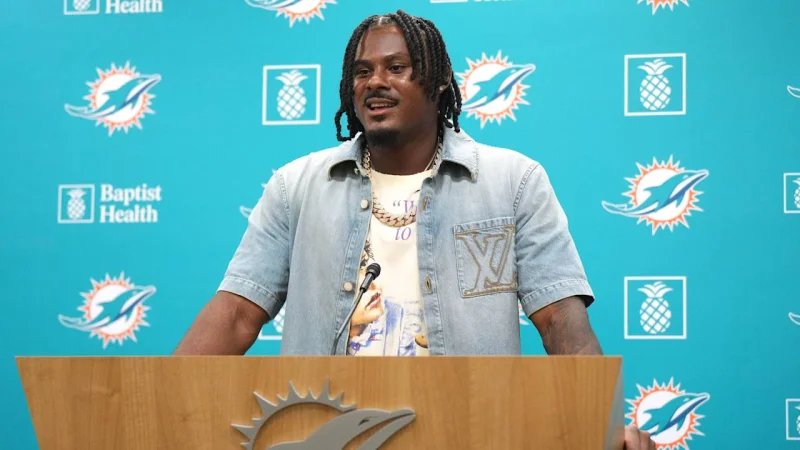
Jeff Hafley’s first major change in Miami was to move Bobby Slowik from passing game coordinator to offensive coordinator, and the Dolphins followed by signing Malik Willis to a three-year contract as the new staff remakes the offense.
On Tuesday, Slowik said the plan is not to scrap the system but to fit it around the players. “It’s always a balance. Again, that’s at every position,” he said. “We have some core beliefs and fundamentals that we really want to make sure we do.”
That matters because Miami is in rebuild mode, and the quarterback move is one of the clearest signs of how the new staff wants to attack that reset. Willis, 26, previously flashed in a backup role in Green Bay and is now getting a fresh chance to push for a bigger role after the Dolphins decided to give him a multiyear deal.
Slowik said Willis brings traits the offense can use immediately. “He can spin the ball all over the field, can throw the ball everywhere, can run, obviously, can use his legs,” he said. That kind of mobility, he added, changes the way defenses have to line up and forces them to account for the quarterback as a real threat.
“I’d say anytime you have a quarterback who has the ability to run, it’s not something that you are going to do down-in, down-out in the NFL, but the threat of it makes it 11 versus 11, as opposed to 11 on 10,” Slowik said. He also said that mobility shows up more often when plays break down than on called runs: “Outside of that, really the mobility these days shows up more in off-schedule situations than it does anything.”
The shape of the offense is already coming into focus. It should look like a Shanahan-tree attack with a few more quarterback runs sprinkled in, a style that keeps the same base principles while making room for what Willis can do with his legs. That is a familiar compromise in the league, but it is especially important for a team starting over.
Slowik’s approach also reflects the lessons of his own career. He previously worked in Houston, where he was criticized for leaning heavily on the run game on first downs. In Miami, the message is different: keep the fundamentals, adapt the scheme, and make the quarterback a problem for the defense instead of a target for it.
For the Dolphins, that is the point of the reset. The staff is not chasing a complete identity change so much as trying to build a version of the offense that can survive mistakes, create easy answers, and make the most of a quarterback who can threaten a defense in more than one way. If Willis gives them that, the rebuild has a real starting point.
The key question now is whether Miami uses that flexibility to settle on a clear direction quickly, or whether the new offense spends the summer still trying to decide exactly what it wants to be.
