The Trump administration told Western state leaders Wednesday that it is drawing up a 10-year plan to deal with water shortages on the Colorado River, signaling that federal officials may move toward mandatory cuts if the states cannot agree on their own.
Federal officials told state water managers in Phoenix that the plan would set specific rules for water reductions and revisit them every two years. The proposal could allow mandatory cutbacks of up to 3 million acre-feet a year in California, Arizona and Nevada, or as much as 40% of the three states’ combined allotments.
The federal briefing came as the seven states that share the river remain deeply divided and still have no agreement after a mid-February deadline passed. Negotiators from California, Arizona and Nevada have offered to use about 1.6 million acre-feet less water annually over 2027 and 2028, but the upper basin states of Colorado, Wyoming, Utah and New Mexico have pressed for a mediator to break the impasse.
Tom Buschatzke, who represents Arizona in the talks, described the federal idea as a “framework,” while Scott Cameron, a federal official involved in the negotiations, has been urging the states to pursue a “consensus-based approach.” The contrast underscores how little ground the sides have gained even after the administration in January released a draft outline of several options and pressed the states to reach a deal by mid-February.
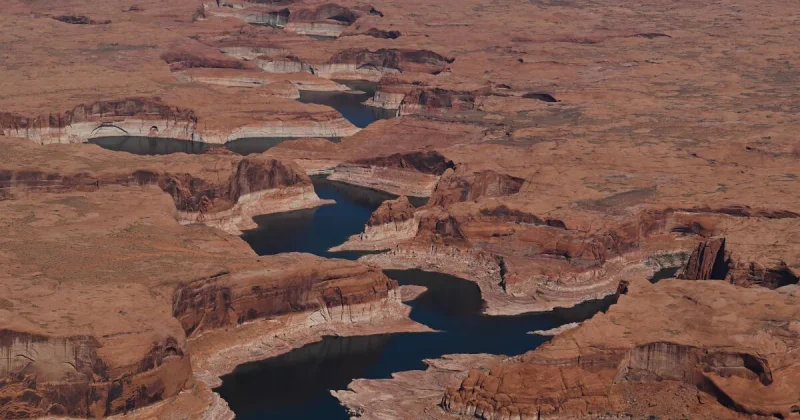
The stakes are rising because Lake Mead and Lake Powell are severely depleted and still falling, leaving little room for more delay. Over the last three years, the states have relied on voluntary water cutbacks and federal payments to farmers who agreed to leave fields dry part of the year, but that stopgap has not produced a lasting accord.
The Colorado River is a major water source for Southern California and much of the Southwest. It supplies about 35 million people and 5 million acres of farmland from the Rocky Mountains to northern Mexico, with farms using about three-fourths of its water, much of it to grow alfalfa and other hay for cattle. Lake Mead, the country’s largest reservoir, sits at the center of the crisis, and the federal plan now emerging appears aimed at forcing a decision the states have not been able to make themselves.
What happens next is whether the administration turns this preliminary 10-year framework into an enforceable rule, and whether the seven-state talks can produce anything that survives the next round of federal pressure.