


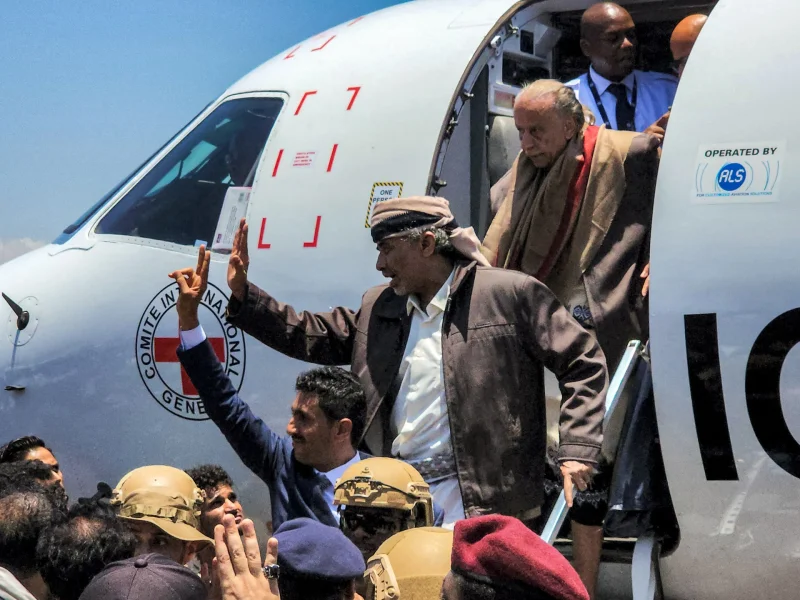
Yemen’s internationally recognised government and the Houthi group signed a United Nations-backed agreement in Jordan on Thursday to exchange more than 1,600 detainees, in what both sides described as the largest prisoner swap since the country’s civil war began in September 2014.
Under the deal, the Houthis will release 580 prisoners, including seven Saudis and 20 Sudanese, while the government will free 1,100 Houthi prisoners. Yahya Kazman said nearly 1,728 detainees from both sides will be released. The agreement also covers coalition forces personnel, members of the armed forces and security services, fighters from different military formations, members of the popular resistance, politicians and journalists who have spent years in Houthi detention.
The exchange comes after more than three months of negotiations in Amman and follows an understanding reached by both sides in December after UN-facilitated consultations in Muscat. The two sides also agreed to hold further talks on additional releases, allow mutual visits to detention facilities and carry out an implementation plan with the International Committee of the Red Cross.
For families on both sides of Yemen’s war, the scale of the deal matters because it goes beyond the smaller swaps that have punctuated the conflict. In April 2023, the two sides exchanged nearly 900 prisoners in a major operation coordinated by the ICRC, a deal that had already been seen as one of the biggest humanitarian gestures of the war.
The broader conflict began after the Houthis seized the capital Sanaa in 2014, prompting a Saudi-led military intervention in support of the government in 2015. That history has left thousands of people in detention and made prisoner exchanges one of the few areas where the two sides have been able to keep talking even as the fighting has dragged on.
Mahdi al-Mashat said the issue of prisoners remains at the forefront of Houthi priorities and called the agreement a historic accomplishment. The Houthis described it as an important humanitarian step toward addressing the issue of prisoners and easing the suffering of their families, while also saying the continued detention of prisoners constitutes a violation of international humanitarian law.
Christine Cipolla said the agreement has brought families closer to the reunifications they have been anxiously waiting for. The ICRC welcomed the deal and said that now the identities of the detainees to be released, transferred and repatriated have been agreed, it is ready to act as a neutral intermediary in carrying out the complex humanitarian operation. The next test is whether the lists, transfers and handovers can be completed on the ground without delay.
