


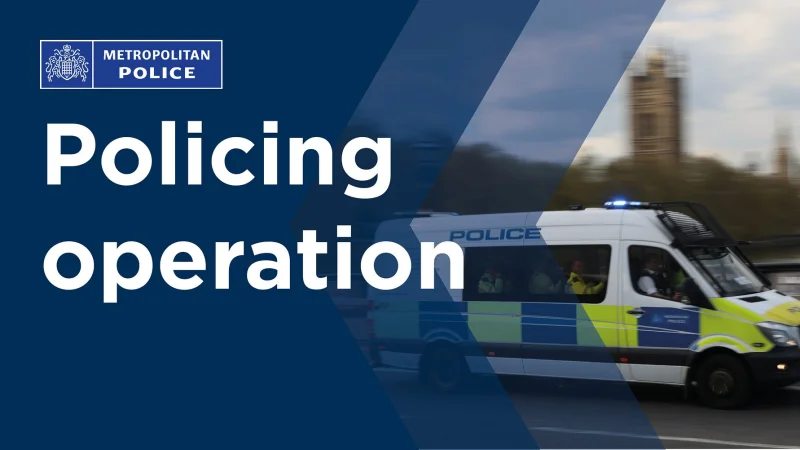
British police are preparing one of their largest operations in recent memory as protests in London this weekend coincide with the FA Cup final at Wembley. More than 100,000 protesters are expected to march through the city on Saturday, when Manchester City and Chelsea kick off at 3pm.
The Metropolitan Police said 4,000 officers will be on duty, backed by armoured Sandcat vehicles and drones. Most of them will be deployed around the far-right Unite the Kingdom march and kept between that crowd and a smaller pro-Palestine counter-march, with the two events separated in central London.
The Unite the Kingdom march is organised by Stephen Yaxley Lennon, better known as Tommy Robinson, a figure who has repeatedly drawn large and volatile crowds. Police expect the largest security burden to fall on that event, not least because the Met has said football hooligans have supported Robinson in the past and social media videos have urged them to join Saturday’s demonstration.
The warning from police comes after the last Unite the Kingdom march in September drew more than 150,000 people into Parliament Square in Westminster. Britain’s largest Muslim group has urged people to avoid central London this weekend, warning that Saturday’s rally could reach a similar size.
The scale of the policing challenge is about more than crowd control. Police now believe prosecutors are more likely to agree charges over what they consider antisemitic chants or slogans, and the slogan “globalise the intifada” has already led to charges against three people. That shift gives Saturday’s speeches and chants a sharper legal edge than a normal march would carry.
The far-right rally is being advertised with speakers including the mother of a woman killed by an asylum seeker and Glenn Beck. Promotion material also includes an AI-generated video that denounces Muslims and ends with Robinson on a stage facing what appears to be a crowd of tens of thousands.
For the pro-Palestine counter-march, the expected turnout is far smaller, at between 15,000 and 40,000 people. But the police planning reflects the risk that the two demonstrations, both politically charged and both capable of drawing passionate crowds, could ignite if barriers fail or tempers rise.
The weekend sits at the intersection of grievance politics, football, and a broader hardening of public debate. Last week, Reform UK won the biggest share of the vote at the English council elections, and in February Lennon travelled to the US and met more than a dozen lawmakers in Washington. The next test in London is immediate: whether the city can absorb a mass protest, a counter-protest and a major cup final all at once without the day breaking wider than police can hold it.
