


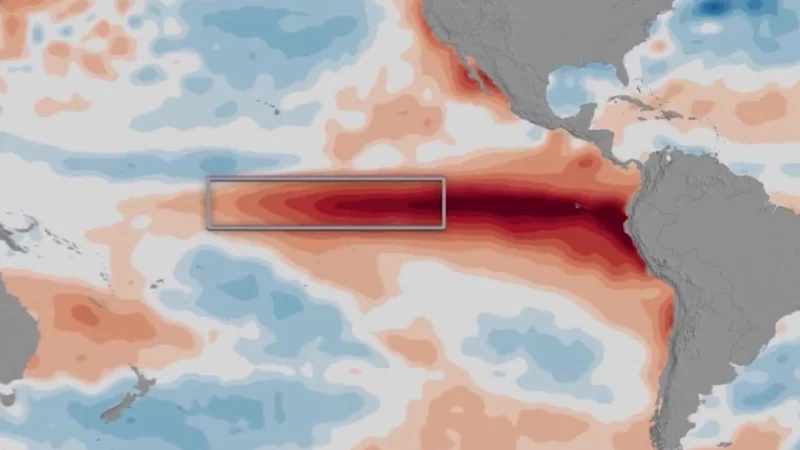
Scientists and climate agencies are sounding urgent alarms over the emergence of El Niño in 2026 — and the data is pointing to something far more severe than a typical warming cycle. Multiple major forecasting bodies now agree this event could rival or surpass records set in 1877, threatening to reshape global weather patterns with devastating consequences for hundreds of millions of people.
El Niño 2026 Official Onset: May to July Window Confirmed
The World Meteorological Organization's latest Global Seasonal Climate Update signals a clear shift in the Equatorial Pacific, with sea-surface temperatures rising rapidly and pointing to a likely return of El Niño conditions as early as May–July 2026.
As of mid-April 2026, the equatorial Pacific was in an ENSO-neutral state but transitioning rapidly toward El Niño, with the IRI forecast placing a 70% chance of El Niño developing in April–June 2026, rising to 88–94% probability for the remainder of the year.
"After a period of neutral conditions at the start of the year, climate models are now strongly aligned, and there is high confidence in the onset of El Niño, followed by further intensification in the months that follow," said Wilfran Moufouma Okia, Chief of Climate Prediction at WMO.
Super El Niño 2026: Could This Be the Strongest on Record?
New ensemble model runs from the ECMWF, NOAA, and BOM now align on a high-impact trajectory, with several forecasts suggesting the 2026 El Niño event could become the strongest in modern history, potentially surpassing the record-breaking event of 1877–1878.
The latest ECMWF forecasts reaching into November 2026 show ocean temperature anomalies peaking above +4.5 degrees in eastern Pacific regions. If that forecast were to verify to that extent, it would constitute a historically record-strong El Niño event.
Super El Niño events tend to occur once per decade or less. The last three such events were recorded in 2015–16, 1997–98, and 1982–83. Scientists warn the 2026 cycle may dwarf all of them.
El Niño Global Weather Impact: Heat, Drought, and Flooding
With more heat released into the atmosphere, stronger heat waves and worsening drought conditions are expected in some areas, while increased atmospheric moisture will drive more intense flooding events in others. El Niño also suppresses the Atlantic hurricane season because the volume of heat in the Pacific outcompetes the Atlantic.

El Niño weather is typically associated with increased rainfall across southern South America, the southern United States, the Horn of Africa, and central Asia, while bringing drought to Australia, Indonesia, and parts of southern Asia.
In summer, monsoon rainfall is reduced across India and Southeast Asia. The Caribbean typically experiences growing drought conditions. Warm and dry winters are forecast for parts of southern and eastern Asia, with drought conditions potentially expanding across Southeast Africa from December through February.
El Niño Weather Impact on the United States
Above-normal temperatures are forecast for Summer 2026 across the northwestern, western, and southern United States, with a low-pressure area over the northern and eastern United States expected to bring elevated rainfall. Less precipitation than normal is forecast across western Canada, southern United States, and Florida.
The American Southwest and Southern Plains have been in drought for nearly six years, with reservoirs, streamflow, and aquifers all critically low. Even a historically wet El Niño season may not be enough to fully reverse the multi-year water deficit, and excessive rainfall without snowpack could instead trigger rapid flooding rather than sustainable recovery.
El Niño 2026 and Wildfire Risk
2026 is already an extraordinary year for climate change-fuelled extreme weather, with wildfires burning more than 150 million hectares globally since January — double the same period in 2024. A strong El Niño "can have a major effect on wildfire risk later in the year," according to Dr Theodore Keeping of Imperial College London.
Forest degradation driven by wildfires, logging, and drought already affects approximately 40% of the Amazon, and scientists warn a strong El Niño weather event could dramatically worsen conditions across the basin in the second half of 2026.
El Niño 2026 and Global Temperature Records
El Niño releases heat stored in the ocean back into the atmosphere, causing global average surface temperatures to rise. A strong El Niño, compounded by existing warming from climate change, could push 2026 or 2027 to set new records for the warmest year in human history.
NOAA has already stated it is "very likely" this year will rank among the five warmest on record — and that calculation does not yet fully account for El Niño's warming impact, which typically peaks during the Northern Hemisphere winter months. Climate scientists urge governments and disaster agencies to begin preparation now.
