


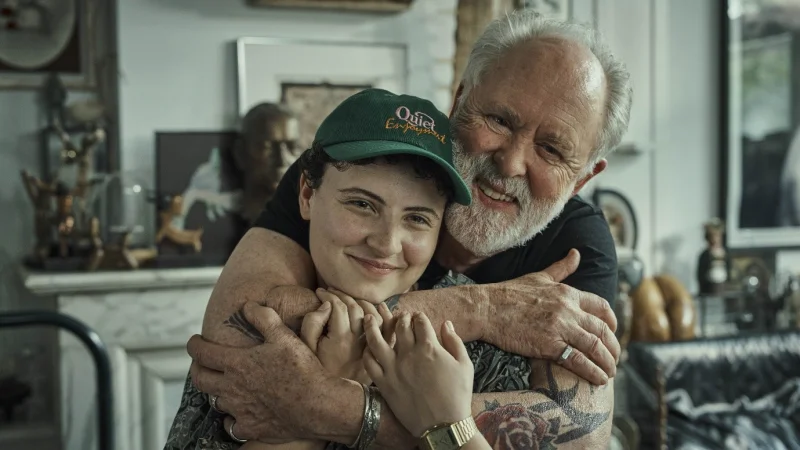
When Hannah flies from Adelaide to Amsterdam with her husband and 16-year-old child in Jimpa, the family trip is already carrying more weight than a simple visit. Then Frances says at the airport that they want to move to the Netherlands and finish their schooling there, and the film’s careful balance starts to shift.
Olivia Colman plays Hannah, a film-maker who has spent years trying to sell an autobiographical feature about two parents in the 1980s who stay happily together as platonic co-parents after the father comes out as gay. That cleaner version of family life is set against the messier reality in Sophie Hyde’s film, where Frances is trans and Hannah and Harry respond thoughtfully to the announcement even as it forces them to confront what their child wants now.
The performance at the center of that family friction belongs to Aud Mason-Hyde, who plays Frances and spent their 19th birthday on set in the middle of what they called a fake argument with their fake mum, directed by their real mum. Mason-Hyde said the role asked for restraint, noting that they are outspoken and opinionated, while Frances is opinionated in a much more observant way. That difference matters in a film built around people trying to speak carefully to one another while still failing to land where the other person needs them to.
Jimpa also turns on the title character himself. John Lithgow plays Jimpa, the gay and often nude septuagenarian father of Colman’s character, a man who has been doing drama for 40 years since he left his family for a fuller queer life than Australia could offer at the end of the 20th century. The name is a compound of Jim and grandpa, and it fits a film that is as much about inherited absence as it is about reunion.
Hyde said Lithgow made one demand clear when they first met: “Jimpa has to be naked!” That bluntness matches the film’s refusal to smooth over its family history. The story brings together intergenerational queerness, filial disappointment and the ways families try to avoid conflict even when conflict has already arrived in the room.
The contrast is sharp. Hannah’s unfinished project imagines a neat, almost utopian arrangement from the 1980s, one in which a gay father can leave romance behind and still remain a fully present co-parent. Jimpa is more interested in what that ideal costs, and in what the next generation does with the emotional debris left behind. Frances is not asking for a theory of family life. They are asking for a place to live and a way to finish school. That makes the film’s central argument less about ideology than about whether any version of family can make room for the person in front of it.
Colman said her own father would have “sat and cried all the way through it,” a reaction that suggests how directly the film reaches for recognition rather than tidy reconciliation. That may be why Jimpa lands today: it is about the old and the young, the queer and the questioning, and the uneasy truth that love inside a family often shows up as patience before it shows up as agreement.
