


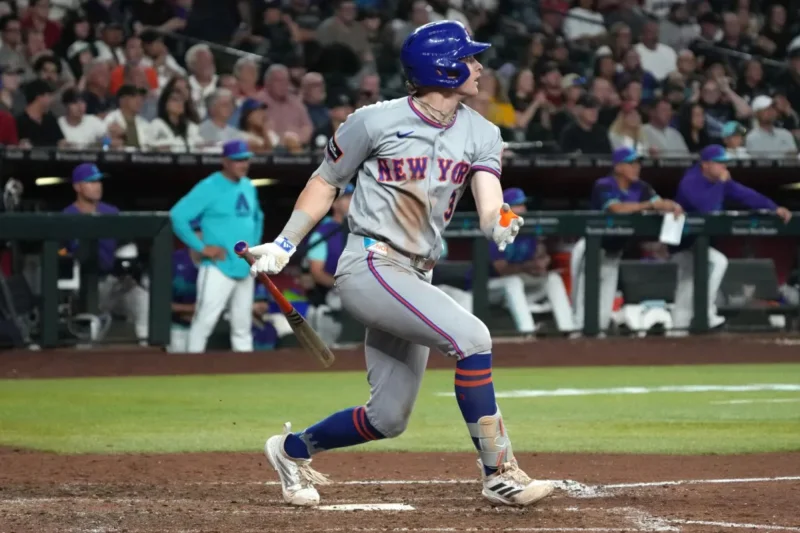
Carson Benge was already the Mets’ best position prospect when he made the club out of spring training, and on Opening Day he gave the moment a jolt with his first major league home run. The rest of the first month looked nothing like that. From March 28 to April 22, Benge hit.127, struck out 16 times and managed only eight hits, a stretch that tested both the rookie and the team’s patience.
The turnaround has come quickly. Over the last 15 games, Benge has hit.326/.283/.558 with two home runs, six extra-base hits and a.941 OPS, while starting more often than not. On Friday in Arizona, he drove in an insurance run with a double in extra innings as the Mets beat the Diamondbacks 3-1, part of a run in which New York has won four of its last five and gone 5-2 since the calendar flipped to May.
Benge’s offensive rebound has not been a mystery inside the clubhouse. Mets hitting coaches Troy Snitker and Rafael Fernandez, along with director of major league hitting Jeff Albert and quality control coach Danny Barnes, noticed early that Benge was setting up in a wider batting stance than he had used in spring training. They showed him data that put his stance openness in the low 20s in degrees, and over the last few weeks he has trimmed that down to under 10 degrees. His feet are now slightly closer together, a small change that has helped him get into a better rhythm at the plate.
That matters because the spring version was easy to see coming. Benge hit.366 with an.874 OPS across 14 spring training games, then lost that feel almost immediately once the games counted. He said the adjustment has helped him settle in, describing it as taking time to get his feet settled before he started to find his groove and get more comfortable. He also said the game now feels more like a juiced baseball game, with balls carrying better as he has begun to square them up again.
Even when the bat went quiet, the glove stayed loud. Carlos Mendoza called Benge an elite defender and said that was important when he was not providing much offensively early on. Mendoza added that Benge has kept playing that defense all over the outfield, with the ability to handle center field, right field and left field giving the manager more flexibility both in the lineup and during games. That kind of value bought the rookie time while the swing was being repaired.
The cleanest sign that the fix is holding came on Friday night. Benge did not need a big game to matter; he simply added a run when the Mets needed one and kept the momentum going for a club that has begun to steady itself in May. The question now is not whether he belongs in the lineup. It is whether the Mets have found the version of Benge they expected when they brought up their top position prospect, the one who can defend anywhere and contribute enough at the plate to stay in the middle of a winning team’s daily plans.
