


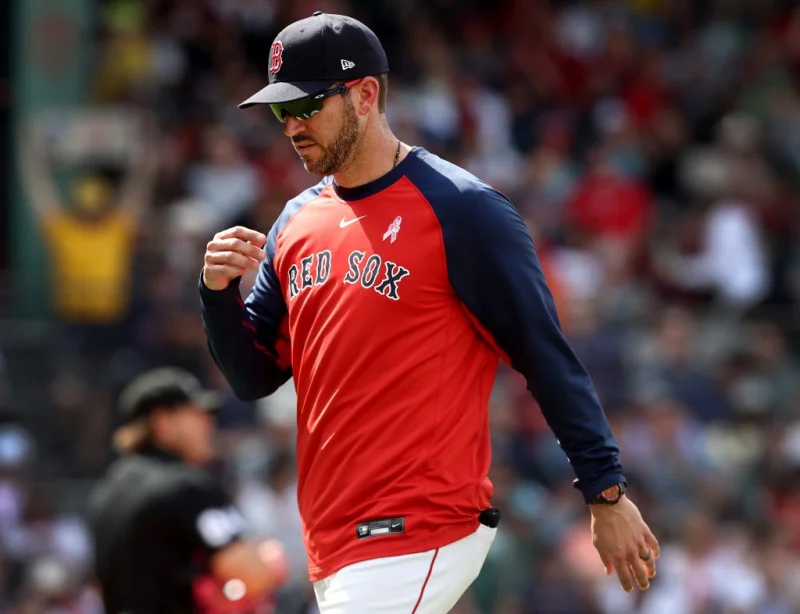
BALTIMORE — Chad Tracy said Tuesday that the last word on the Red Sox lineup belongs to him, putting the former Triple-A manager in charge of the daily decisions that became a flashpoint under Alex Cora. Tracy, who took over as interim manager last month, said the lineup card is ultimately his responsibility even when he has a preferred construction in mind.
“This is what I’d like to do,” Tracy said. “That’s always, always the case. But the final pen-to-paper is my call.”
The assignment lands in a clubhouse still shaped by the upheaval from three weeks ago, when Craig Breslow, Sam Kennedy and John Henry flew to Baltimore and fired Cora, then gutted the coaching staff. Lineup construction was one source of friction between Cora and Breslow, and it came against the backdrop of a roster that left the manager trying to balance playing time among five outfielders: Wilyer Abreu, Roman Anthony, Jarren Duran, Ceddanne Rafaela and Masataka Yoshida.
That is the sort of problem Tracy has spent years thinking through in the minors. He managed the club’s Triple-A affiliate from 2021 until last month, and he said the logic changes once a lineup is built for the big leagues rather than for development alone. In the minors, he said, the question is who on the 40-man roster can help immediately and which top prospects need at-bats. “Who’s on the 40-man (roster) that’s immediately going to help us (in the big leagues)? Who are top prospects that we need to see get in the batter’s box a lot?” Tracy said.
Even there, he said, the math matters. A hitter batting first rather than sixth can mean the difference of 100 plate appearances in a year, and that is the sort of edge clubs guard carefully. Tracy said he still tries to avoid stacking four lefties in a row when he can. “you still try to not put four lefties in a row if possible, but it’s less of a priority than it is here,” he said.
For the Red Sox, the question is not just who plays, but where those players hit and how often they see the field. Cora had openly acknowledged how difficult it was to juggle the outfield rotation, and the same pressure now falls to Tracy as he tries to keep the lineup productive without turning it into a weekly compromise. Rafaela is part of that equation, and so are the others crowding the same defensive and offensive lanes.
What makes the job more delicate is that Tracy is not only managing personalities or matchups. He is managing a roster built with competing needs, some immediate and some developmental, and the balance can shift from one day to the next. His background suggests he will lean on the kind of practical lineup thinking that dominates the minors, but the major leagues leave less room for patient experimentation and more scrutiny on every move.
That is why his comment about the lineup card matters beyond one game. The Red Sox have already lived through a front-office intervention, a manager’s firing and a staff overhaul. Now the daily lineup is Tracy’s call, and the next test is whether that authority produces a cleaner answer than the one that helped unsettle the job in the first place.
